Every basis point, explained.
Beating the benchmark is a result. Knowing which decisions produced it is an ability. Attribution turns one into the other.
Allocation effectSelection effectInteraction
Brinson–Fachler decomposition · the industry standard for performance attribution
A portfolio outperforms by two percent. Was that the allocation calls, the security picks, or the two accidentally working together? Without attribution the honest answer is that nobody knows, and a result nobody can explain is a result nobody can repeat.
Attribution follows Brinson–Fachler: the allocation effect for each segment is measured against the total benchmark return, so overweighting a segment that beat the benchmark overall contributes positively. Selection is measured inside each segment, against that segment's own benchmark return. Interaction is reported separately from selection. What emerges is a clean separation of the two skills that active management actually consists of, plus the interaction term that keeps both measurements honest.
In Cadran the segments are the sub-asset classes defined in your strategic asset allocation, so the attribution reads in exactly the terms your strategy is written in. And because the decomposition needs only weights and returns per segment, the same arithmetic works for sectors, countries or entire asset classes.
This is what makes attribution a governance tool, not just an analytics view. It gives boards and committees a defensible account of where performance came from, in a language auditors and consultants already speak. In Cadran it runs continuously, by sub-asset class, over any window you choose.
Three effects, cleanly separated
Allocation effect
The value added, or lost, by over- and under-weighting each segment against its benchmark weight, measured against the total benchmark return. Being heavier in US equities pays off when US equities beat the benchmark overall, regardless of which names you picked.
Selection effect
The value added by picking the right securities inside each segment, measured against that segment's own benchmark return. It isolates selection from positioning, so a good picker in a weak segment still gets credit for the picking.
Interaction
The part of active return that comes from the two decisions compounding: an active weight applied to a segment where selection also differed from the benchmark. Cadran reports it on its own line rather than folding it into either effect.
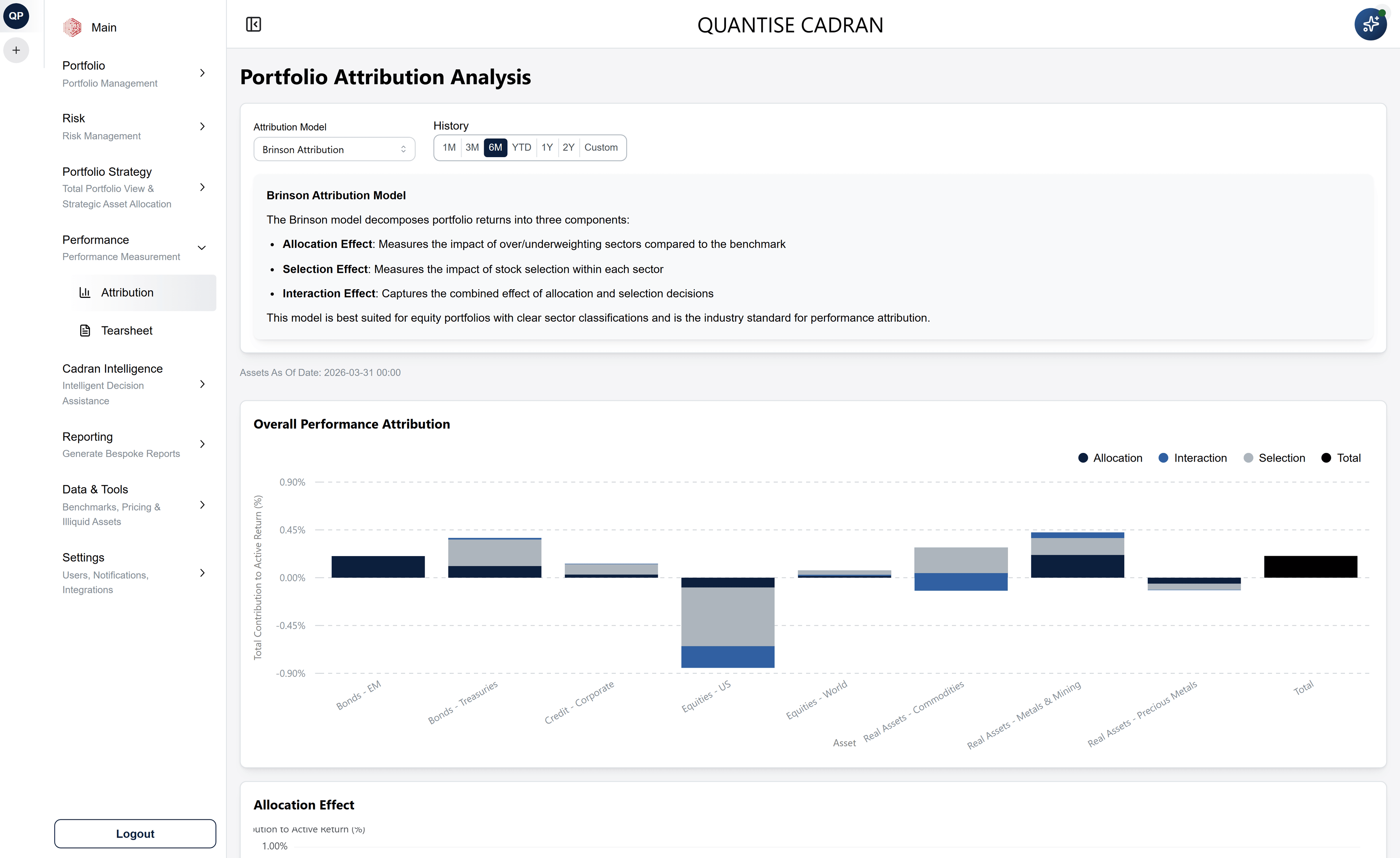
Attribution in Cadran · overall performance attribution by sub-asset class
Know where your return comes from.
Attribution runs continuously in Cadran and exports to board-ready, white-label reports.