Language for the question. Mathematics for the numbers.
Harry is an assistant you can question, on numbers you can trust. That takes an architecture, not just a model.
How modern AI actually worksThe Harry architectureWhy Harry is more robust
How modern AI actually works
Large language models are remarkable at language. They read a question, weigh billions of learned patterns and produce the most plausible continuation, word by word. That is what makes them feel fluent, and it is genuinely useful: they summarise, explain, translate and reason about text better than any software before them.
But plausible is not the same as true. A language model is a probabilistic system: when it writes a number, it is predicting what a number should look like in that sentence, not calculating it. Ask twice and you may get two different answers, each delivered with equal confidence. The industry calls the failure mode hallucination. In most settings it is an inconvenience.
In portfolio management it is disqualifying. A risk figure that is merely plausible is not a risk figure. You deserve numbers you can trust and defend, not numbers that rely on the probabilities of a text generator.
The Harry architecture
Two lanes with a strict division of labour. Language on one side, mathematics on the other, and numbers only ever flow one way.
- 01Parses the questionRisk, concentration, drift or factor exposure, asked in plain language.
- 02Selects the analysisMaps your question to the matching analytics in the engine.
- 03Renders the resultPuts verified figures into a clear, plain-language answer.
- 01Computes the figuresVaR, exposures, drift and attribution, calculated deterministically.
- 02Reproducible by designThe same inputs and method always produce the same number.
- 03Traced and auditableEvery figure carries its lineage: data, method, timestamp.
An answer in plain language.
Every figure computed, traced and auditable.
Why Harry is more robust
Harry uses the language model for exactly what it is good at: mapping the wording of your question onto a defined analysis, and putting the result back into readable prose. The moment a figure is needed, Harry hands the question to Cadran's quantitative engine, the same deterministic engine behind every dashboard on the platform, and passes the verified result through untouched.
The consequence is simple but rare in AI products. Every figure Harry reports is rendered from a computed result and linked to the calculation that produced it. Harry does not generate numbers in prose. Ask about concentration, drift or factor exposure and the figures in the answer are the figures in the platform, reproducible on demand and traceable to their data and method. If something cannot be computed, Harry says so instead of improvising.
We make no claim that Harry understands your portfolio. It matches questions to analyses and puts numbers into sentences. The judgement stays with you; the arithmetic stays with the engine.
The Cadran name points the same way: the dial of a Swiss mechanical watch. A movement does not estimate the time, gears either mesh or they do not. That is the standard Cadran holds its numbers to, Harry included. The machinery is deterministic; only the phrasing is generated.
A general chatbot versus Harry
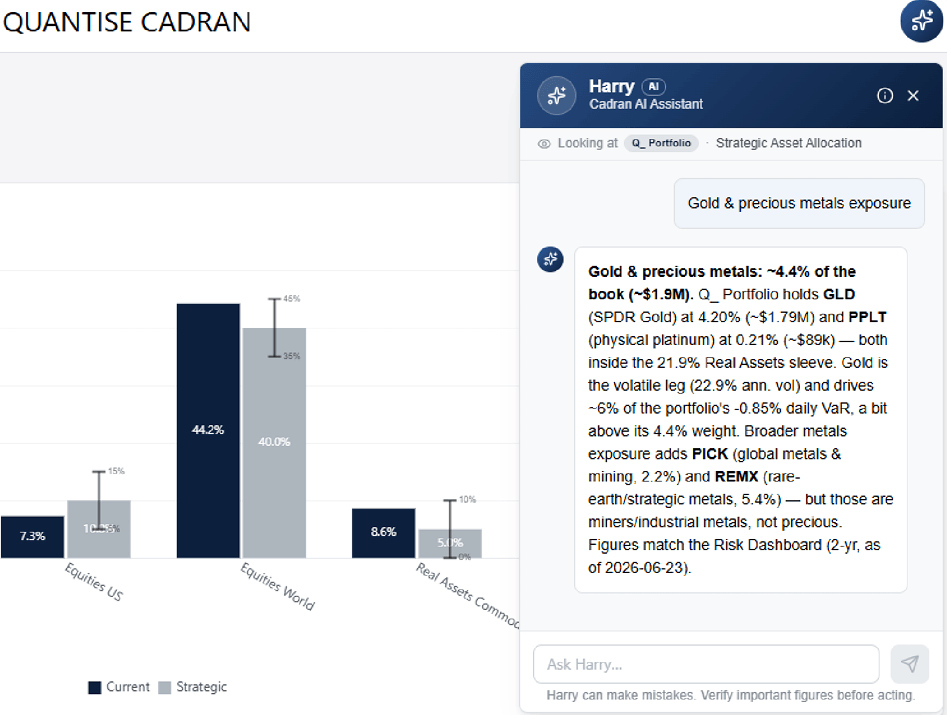
Harry in Cadran · a plain-language answer with computed figures
Ask your portfolio a question.
Harry is part of every Cadran workspace, on top of the same engine that powers the dashboards.